


Best Trade Ideas for April
I know we've had quite an amazing run these past few month, with over 78% accuracy in our trade ideas and sentiments, and thousands of pips in profits monthly...

Don’t waste your time – keep track of how NFP affects the US dollar!
Data Collection Notice
We maintain a record of your data to run this website. By clicking the button, you agree to our Privacy Policy.

Beginner Forex Book
Your ultimate guide through the world of trading.

Check Your Inbox!
In our email, you will find the Forex 101 book. Just tap the button to get it!
Risk warning: CFDs are complex instruments and come with a high risk of losing money rapidly due to leverage.
66.43% of retail investor accounts lose money when trading CFDs with this provider.
You should consider whether you understand how CFDs work and whether you can afford to take the high risk of losing your money.

Warning! Old version of the browser!
Press one of the icons below to proceed to the official website of the developer and download the latest version of your browser.


Online Forex broker
Information is not investment advice
From the investors’ point of view, the year 2020 starts on a positive note. As Donald Trump highlighted in his shining speech in Davos on Tuesday, the United States have almost entirely reconfigured the global trade setting. Thanks to the current administration (as per Mr. Trump), the country is now in a much-improved position, in relation to other countries. US-China deal, US-Canada-Mexico agreement, other coming deals with the UK, Japan, and South Korea – all of that surely brings more certainty to the global economic vibe. Particularly, it brings more risk appetite among investors, who now prefer something more adventurous than the US Dollar. In consequence, demand for the greenback is weakening, putting it under pressure. That is exactly what the US President wants to see: as he strongly supports the US exports, depreciation of the USD benefits American exporters. Hence, the question is, how long the environment will be reassuring enough to keep investors away from the US dollar, favoring US merchandise and services sold abroad, to the lasting joy of Donald Trump.
Since Summer 2018, the US Dollar index has been showing a rising trend, due to the US-China trade conflict and other negative influence factors arising in the midst of this trade war. Altogether, that kept investors interest in the US Dollar at high levels, and demand for the currency was growing. However, October 2019 was the month when it became finally clear that the US and China are indeed willing to put an end to the trade disputes. In confirmation, the Phase One deal to be signed later on was announced. Consequently, investors felt safer and stopped fleeing accumulating reserve assets, and the US Dollar in particular.
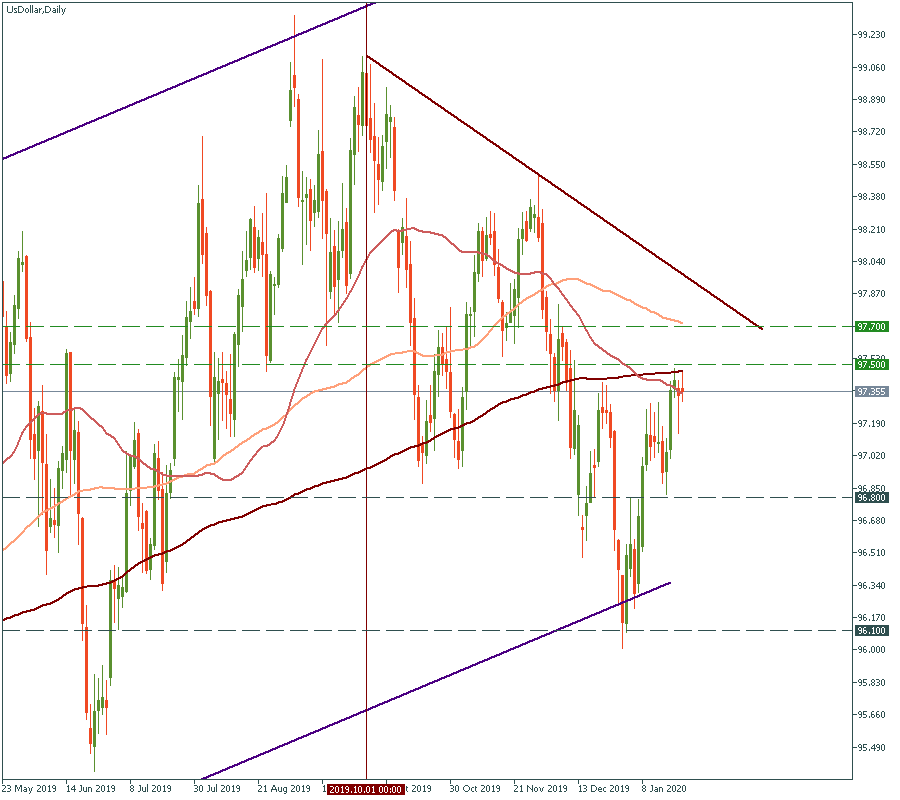
That’s why since then the two-years uptrend is very close to a reversal. The current level of 97.35 is a local high. It was reached when the index bounced back up after dropping to 96.10 – the summer-2019 low. Also, a “death cross” was formed by the 50-day Moving Average crossing the 200-day upside-down – that’s about the resistance level of 97.50, which is tested by the index currently. If the index breaks it on the way up, it will be likely to touch the secondary resistance of the 100-day Moving Average at the level of 97.70. Otherwise, if the trajectory makes another dive down as it seems likely to, the support of 96.80 will be the first threshold to check the downward movement. If it is passed, the index will aim at the support of 96.10, questioning the entire long-term uptrend.
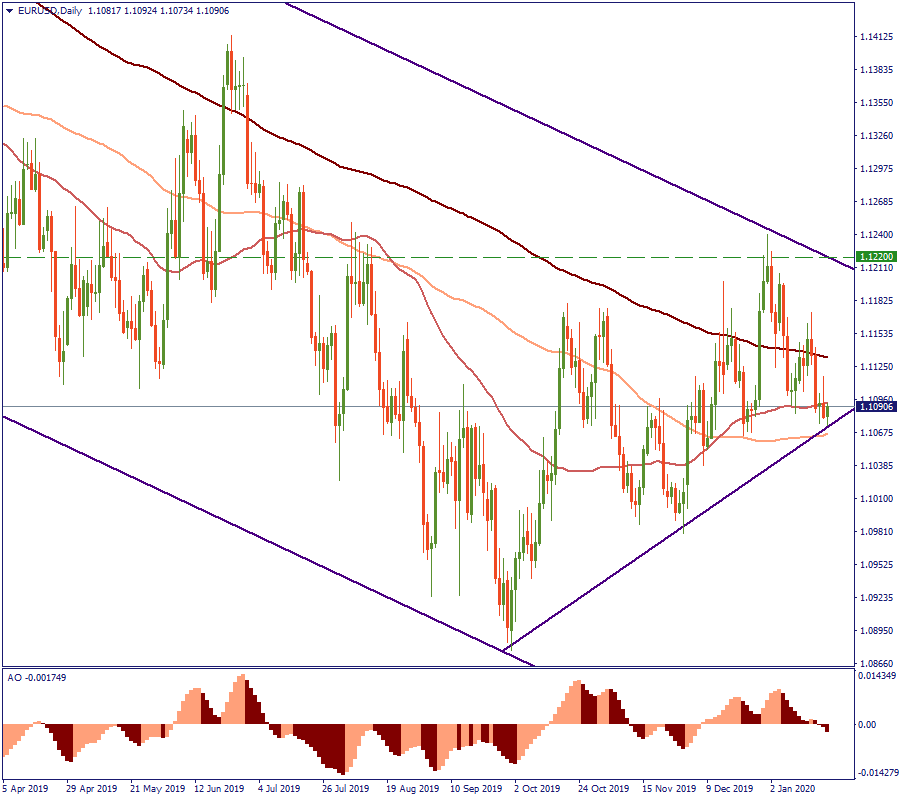
The daily chart of EUR/USD confirms the tendency and time zones we have noted with the US Dollar index. Since the first part of 2018, the Euro has been consistently depreciating against the USD. But that changed in Autumn 2019 for the reasons explained above. Currently, the price is at 1.1090 – that is a bounce back after it reached 1.1220, a summer high. At the same time, that is about the area where the larger downtrend collides with the local upswing. If the uptrend climbs to the resistance of 1.1220 again and goes further, we will see a new long-term trend forming.
Conclusion
The short-term seems to offer a relatively high probability of the US Dollar index climbing to the local resistance. But in the mid-term, if the peaceful economic environment doesn't change, there is high likelihood that it will go further down in course of depreciation of the American currency. Watch the levels, stay updated, and trade smart!
I know we've had quite an amazing run these past few month, with over 78% accuracy in our trade ideas and sentiments, and thousands of pips in profits monthly...
Futures for Canada's main stock index rose on Monday, following positive global markets and gains in crude oil prices. First Citizens BancShares Inc's announcement of purchasing the loans and deposits of failed Silicon Valley Bank also boosted investor confidence in the global financial system...

Investor confidence in the global financial system has been shaken by the collapse of Silicon Valley Bank and Credit Suisse. As a result, many are turning to bearer assets, such as gold and bitcoin, to store value outside of the system without...

eurusd-is-falling-what-to-expect-from-the-future-price-movement
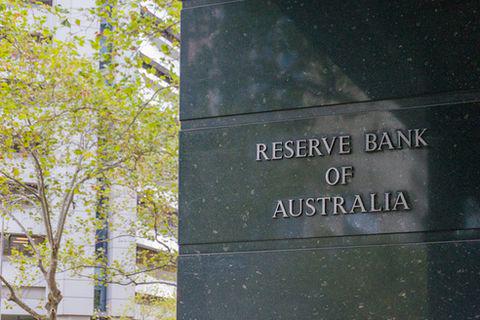
Greetings, fellow forex traders! Exciting news for those with an eye on the Australian market - the upcoming interest rate decision could be good news for Aussies looking to refinance or take out new loans. The Mortgage and Finance Association Australia CEO, Anja Pannek, has...

Hold onto your hats, folks! The Japanese yen took a nosedive after the Bank of Japan (BOJ) left its ultra-loose policy settings unchanged, including its closely watched yield curve control (YCC) policy. But wait, there's more! The BOJ also removed its forward guidance, which had previously pledged to keep interest rates at current or lower levels. So, what's the scoop? Market expectations had been subdued going into the meeting, but some were still hoping for tweaks to the forward guidance to prepare for an eventual exit from the bank's massive stimulus







Your request is accepted.
We will call you at the time interval that you chose
Next callback request for this phone number will be available in 00:30:00
If you have an urgent issue please contact us via
Live chat
Internal error. Please try again later